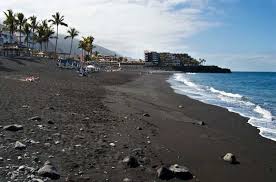
A beach of black volcanic sand, famous for its calm waters and palm trees, located on the west coast of La Palma. A traditional tourist enclave currently undergoing recovery.
Ask AI about this beach
Instant answers about Playa de Puerto Naos

Recomendaciones
👀 Did you know...?
El reflejo del sol en el agua puede causar queratitis (quemadura ocular). Usa gafas de sol con filtro UV.
About this beach
Table of contents
Introduction
As experts in Spain's coastal wonders, we have always had a special affection for Playa de Puerto Naos. Located in the idyllic municipality of Los Llanos de Aridane, on the sunny island of La Palma, this beach has been an emblem of Canarian tourism for decades. With its characteristic black volcanic sand, its serene waters, and the iconic promenade flanked by palm trees, Puerto Naos represented the essence of relaxation and the natural beauty of La Palma.
However, it is crucial to address the current reality with honesty. The eruption of the Cumbre Vieja volcano in 2021 profoundly impacted life on the west coast of La Palma, including Playa de Puerto Naos. Although the beach and the village suffered the onslaught of lava flows and, more recently, gas emissions, the spirit of the community and the promise of its recovery remain intact. This article is a tribute to what Playa de Puerto Naos has been, a guide to what La Palma continues to offer, and a hopeful look towards the bright future that, we are sure, awaits this magical corner. We want to share with you the undeniable charm of this place, its history and its resilience, inviting you to discover the beautiful island in its entirety while we await its full reopening.
How to get to Playa de Puerto Naos
Getting to Playa de Puerto Naos under normal conditions is a scenic journey that immerses us in the beauty of La Palma's western coast. Starting from Los Llanos de Aridane, the main urban center of the Aridane Valley, the journey by car is approximately 15-20 minutes, covering about 7-8 kilometers. The main road, the LP-213, takes us on a winding descent through agricultural landscapes of banana and avocado plantations, offering spectacular views of the Atlantic Ocean and, on clear days, of the island of El Hierro on the horizon. It is a well-signposted and well-maintained road, although with some curves that invite careful driving to enjoy the landscape.
Transport options
- Rental car: It is, without a doubt, the most comfortable and flexible option for exploring La Palma. It allows us to move at our own pace and discover hidden corners of the island. From La Palma Airport (SPC), the journey to Los Llanos de Aridane is about 40-50 minutes, and from there, the descent to Puerto Naos is direct.
- Bus (guagua): Before the eruption, there were regular bus lines connecting Los Llanos de Aridane with Puerto Naos, making the beach accessible for those who preferred public transport. La Palma's bus network is efficient and a good economical option. However, it is vital to check current routes and schedules, as the situation in the area may have affected the operation of some lines.
- Taxi: A quick and direct option, especially if we don't want to worry about parking or if we are traveling with luggage. Taxis are available at the airport, in Santa Cruz de La Palma and in Los Llanos de Aridane. We recommend agreeing on the price or ensuring the taximeter is running.
The sand and the water
Playa de Puerto Naos captivates us immediately with its uniqueness. Here, the sand is not golden or white, but of a deep and shiny black color, a testament to its volcanic origin. It is a fine and soft sand to the touch, which warms under the La Palma sun in a special way, inviting us to walk barefoot and feel the energy of the earth under our feet. This contrast between the intense black of the sand and the turquoise blue of the Atlantic creates a visually striking landscape, truly photogenic and unique in the Canary Islands.
We love how the sun plays with the small basalt crystals that make up this sand, making it shine as if sprinkled with tiny stars. It is a very different sensory experience from other beaches and constantly reminds us that we are on an island forged by the force of nature. The beach extends for about 600 meters, offering ample space for recreation, even during peak times. Its width means that, even at high tide, we always have a good stretch of sand to enjoy.
As for the water, the geographical characteristics of Playa de Puerto Naos make it a haven of tranquility. The bay is protected from the stronger ocean currents, resulting in generally very calm and crystal-clear waters. This makes it exceptionally safe for swimming, ideal for families with young children and for those who simply want to relax floating or swimming without worries. The water temperature, influenced by the Canary Current, is pleasant all year round, ranging from 19°C in winter to 24°C in summer, inviting us to a refreshing dip in any season.
The transparency of its waters is also a delight for snorkeling lovers. Although it does not have large coral reefs, marine life is abundant and varied, with schools of colorful fish, starfish, and occasionally, an octopus or squid hiding among the rocks on the bottom. Diving into these waters is an opportunity to connect w